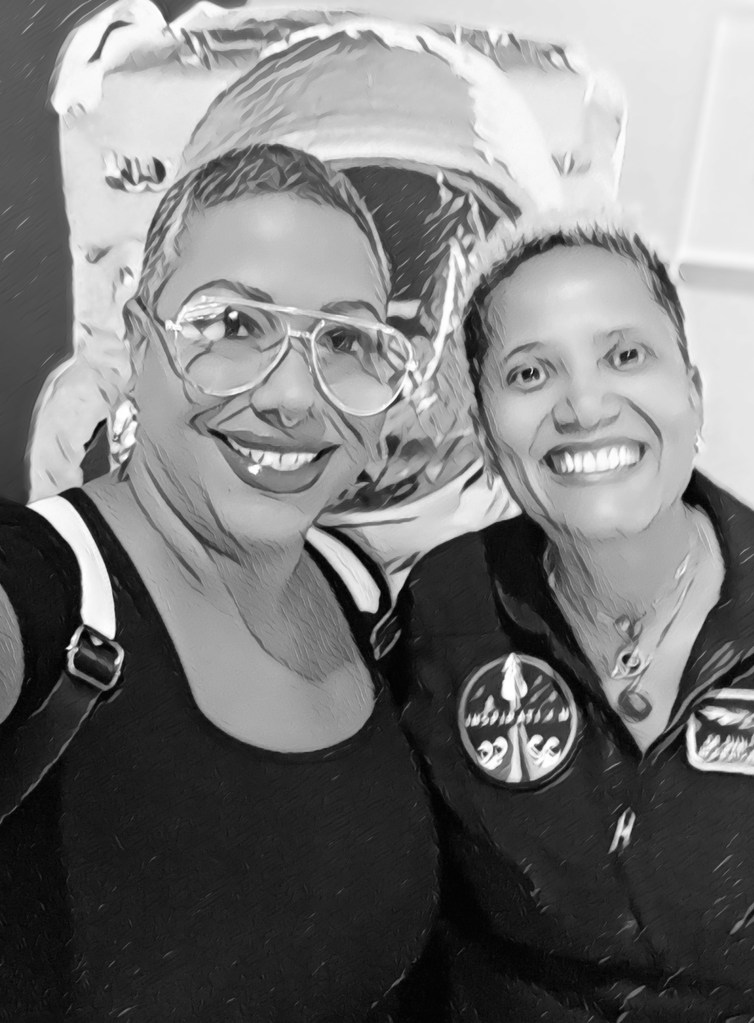
The first time I said the iconic phrase for space geeks everywhere while piloting the space shuttle simulator, Enterprise, I had to take a moment to smile and experience a deep sense of wonder and gratitude. As a faculty recipient of the first Proctor Foundation Space Camp scholarship, I was given the unique opportunity to attend the Adult Space Academy at the U.S. Space and Rocket Center in Huntsville, Alabama with colleagues and community college students. And of course, THE Dr. Sian Proctor, herself. No pressure.
I feel a visceral sense of awe and bewilderment when I think of the roads that MS had led me to travel. As one who first memorized “A Road Not Taken” in fourth grade, the poem’s words became a recurring motif in my head whenever I dared to set off for another adventure. Taking the road less traveled is a key constituent of who I am. Yet still, I never would have imagined that “not letting MS stop me” would lead to me piloting a simulated mission to the International Space Station and back after a crew transfer. While being watched and occasionally filmed by the first black woman to pilot a spacecraft. Again, no pressure.
But like many experiences in my life, it was both familiar and unfamiliar at the same time. I had wanted to go to Space Camp since I first watched the film on VHS while piled among pillows, blankets, and pre-teens at a neighbor’s house in the 80s. Space had me the word “planetarium.” When we went on a second-grade field trip, I fell in love with the Orion and Sirius constellations. Growing up, I wanted to be an astronaut until society convinced me I could not. Watching the launch broadcast that ended with the deaths of Christa McAuliffe, the first teacher in space, and Ronald McNair, the second black American in space, did not help. Yet here I was, 37 years later, an educator, piloting a shuttle simulator, a year after earning my Ph.D., NASA flight suit and all.
Astronauts inspired many aspects of my life, from my general fascination with the night sky to becoming a Ronald McNair Scholar during my undergraduate years. The purpose of the program was to prepare first-generation college students, those from lower socioeconomic conditions, or underrepresented populations to pursue doctoral studies. I happened to be all three. Although I did not complete my doctorate until twenty years later, Ronald McNair and my MS diagnosis played a significant role in that as well.
As I navigated the flight plan and communicated the many anomalies we encountered on the mission, I had to contact “Houston” several times. Finally, when all of the sensors started flashing at once, I decided to crack a joke in honor of Jay-Z’s classic song title and told Houston we “have 99 problems, but a b*tch ain’t one.” In many ways, I have 99 problems, but I refuse to let MS be one.
Trying to describe what Space Academy meant to me is like trying to describe the visceral sense of awe and wonder I feel as I look at the night sky, using my fist and the Big Dipper to find the North Star. That weekend, the expansive macrocosm of the Cosmos became a part of me. A spark of the Universe. And although I do not know where this experience will lead me, akin to my journey with MS, one week after piloting a simulated shuttle mission, I found myself on the steps of The Cradle, in Evanston, Illinois. The adoption agency where I spent the first two months of life before I was “returned to mother,” was celebrating its 100-year anniversary. While I may have left that nursery nearly 50 years ago as a “biracial” fledging in this complicated world, I returned as an accomplished educator with a doctoral degree and my Space Academy wings despite any obstacles that have crossed my path. Not bad for a black child born to an unwed German-Irish mother at the beginning of the post-civil rights era.
Thank you, Doctor Proctor.
 What it is Like ...
Leave a comment